Monday, March 7, 2022

Tempted vs. Tested


Luke 4:1-13

Lent 1 / Year C

If you are looking for some entertainment after today’s service, go to YouTube and search for “The Marshmallow Test.”  Multiple videos will come up.  Choose one that is short and shows children.  The Marshmallow Test is a simple experiment designed to measure the ability of four-year-olds to delay gratification.  The child is sitting at a table.  An adult places a single marshmallow on a plate in front of the little tyke.  The adult then explains she must leave the room for a few minutes.  The child is told he/she is free to eat the marshmallow now, but will receive a second marshmallow if he/she saves the first until the adult returns.  When the adult tester leaves the room the four-year-old is alone (although secretly is being video-recorded). 

[Check out the video here: (205) PARENTING SCIENCE: The marshmallow test - YouTube]

The struggles these little boys and girls go through is hilarious.  One boy puts his finger on the plate and spins it round and round.  Several children touch the treat and some actually pick it up.  They smell it.  They squeeze it.  They lick it.  One child pulls off a small section and eats it.  Another uses her finger to poke a hole through it.  I know of no other video which so vividly portrays the experience of being tempted.

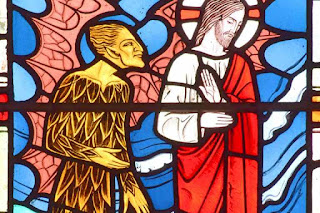
The first Sunday in Lent always takes us with Jesus into the wilderness where he fasts for forty days and is tempted.  The Gospels tell us the Temptation follows closely after Jesus is baptized: the moment the Holy Spirit falls upon him and a voice from heaven proclaims him “My Son,” thus giving Jesus a new identity.  The Spirit then leads Jesus into the wilderness.  There is a connection here with the people of the Exodus who wander, not forty days, but forty years in the wilderness and also are tested.  Their time in this barren landscape is designed to help them learn how to live into their new identity as God’s people.  So it is with Jesus.  While the Hebrews fail in the face of testing several times, Jesus does not.  He meets every test and masters every temptation.

Did you notice how at the beginning of the text it says Jesus is “tempted” by the devil throughout his time in the wilderness and how at the end it says the devil finishes every “test” and departs until an opportune time?  It occurs to me tempting and testing are not exactly the same thing, are they.  Temptation has something to do with being enticed or lured into sin, resulting in a fractured relationship with God and (often) with others and even with yourself.  Testing, on the other hand, challenges the vigor of our faith and commitment.  In his Epistle, James contends testing leads to endurance and character.  We might say temptation challenges us to give in while testing challenges us to give up.

Testing.  My college had four required “key” classes: one in religion, another in humanities, another called ‘creative’, and yet another in science.  No one could graduate without passing all four.  Guess which one was my biggest challenge.  Right, science. 

The final consisted of 50 multiple choice questions and an essay.  For the multiple choice you filled in a computer card with a #2 pencil.  Halfway through the process I realized I had skipped a question and I had been miss-recording the majority of my answers.  So, my answer for Question #25 was recorded on the line for Question #24… and so one. 

The classroom was one of those large, tiered, theatre style rooms, and I tried desperately to get the attention of a teaching assistant.  Losing time, I decided to start on my essay.  Finally, an assistant came to me and I explained my situation.  He said he would bring me a new computer card, which he did.  He placed it on my desk, as I continued to work on my essay.

Once I finished writing, I took up the card ready to begin the process of transferring my answers up until the question I had skipped over.  It was not until then that I noticed my new card was completely and immaculately filled in.  I immediately deduced I had been handed an answer key.  And let me tell, you, the pattern of its answers – B, D, C, C, A, (and so forth) looked nothing like the pattern of my answers! 

Once again I attempted to get the attention of an assistant, which again took some time.  I then explained how I got to this point and my suspicion about the new card.  Somewhat nervously (and unconvincingly) he told me, “Oh no.  This is not an answer key.”  He took the card and went down to speak to the professor.  They were too far away for me to hear their conversation, but I could read the professor’s lips as he said, “Where did you get this?  That’s the answer key”.  The two talked some more and the assistant pointed up at me.  Then all of the assistant’s huddled with the professor and, after some time, someone brought me another new (and most assuredly blank) card.  I kept my answers as I initially recorded them, now knowing some of them were wrong.

After the test I went back to my room and told my story to my roommate.  “I think God is going to bless me for doing the right thing,” I told him.  His response: “You fool.  God was providing for your every need!”

I was never tempted to turn in the answer key as my own work, nor was I tempted to transfer its answers to my new card.  Nothing about this was alluring to me.  This test was a test – a trying of my core principles and beliefs.  More than a test in science, it was a test of character.  And, to be honest, it wasn’t so much of a trial (a difficult experience) as it was a revealing of who I am and what I value in myself.  It spoke to me of my identity. 

Which do you experience more – temptation or testing?  My temptations are subtle and difficult to identify.  I am tempted to think injustice and corruption are not my problems and there is nothing I can do about them.  I am tempted to think it is other people who are mean and hateful and dividing our country, but not me.  I am tempted to think other people need to do more, but I do enough.  I am not tempted by marshmallows. 

When I think about testing I think about those of you who are living with illness and chronic pain, who are unemployed, or who are battling addiction.  I imagine these kinds of test are incredibly challenging as you attempt to live out who you are committed to be.

And, like most of you, I think this morning of the people of Ukraine who are being tested in a way no one ever should be.  The free world is praying fiercely for them and is watching with awe and admiration as they sacrifice all to remain true to their country and to their core principles. 

Our Lord and Savior, when he was tempted never gave in.  When he was tested he never gave up.  And he promises to stand with us when we are tempted and when we are tested so that his faithfulness may become our strength.  May this be your experience as you move forward in this Lenten season and throughout life.


Thursday, March 3, 2022

Ashes & Gratitude


Ash Wednesday

Perhaps of all the services we hold over the course of a liturgical year, what we do today is the most counter-cultural.  In a “look at me” society placing a premium on self-aggrandizement, the Ash Wednesday service lifts up modesty, discretion, and privacy.  In a society teaching us we are perfect and anything that goes wrong in our lives is someone else’s fault, this liturgy directs us to own up to our failures, shortcomings, and misdeeds.  In a society which says you can (and should) have it all, this service calls us to fasting and acts of self-giving and selflessness.  In a society where people scurry to outlets and sources which defend and reinforce what you already hold to be true, this service says one aspect of a holy observance is the intentional reading of Scripture and meditating on its meaning.  In a society obsessed with youth, beauty, and vitality, the Ash Wednesday liturgy speaks of mortality… remember you are dust and to dust you shall return. 

Is it any wonder prosperity-gospel mega-churches and the power of positive thinking houses of worship and pop-culture imitating big-box churches don’t impose ashes and won’t engage their consumers in a Litany of Penitence today?  They won’t call on their members to examine all the ways their faith and practice have been absorbed into the climate of our times.  And they definitely won’t speak of mortality beyond if you died tonight do you know where your soul would go.  Yes, what we are doing is counter-cultural. 

And it is ancient.  The association of ashes with penance and mortality predates Jesus and is found in the Old Testament.  The Imposition of Ashes emerged in the Christian Church somewhere in the 6th Century.  The practice in our country was associated mostly with Roman Catholicism until the 1970’s.  Around that time, as people in other denominations began to discover the value of multi-sensory spiritual experiences, the Ash Wednesday service grew in popularity.

More recently, something called “Ashes-to-Go” has taken off.  It was initiated by a Chicago-area Episcopal priest on Ash Wednesday 2010.  He took ashes to a station where commuters waited for a train into the city.  The idea was to provide access to the ashes to folks whose schedule might not allow them to attend a service in a church.  He found people were hungry for a moment of prayer and reflection in the midst of their busy life. 

He shared the story of his experience and the practice is catching on across the country.  Clergy vest and stand outside coffee shops, busy civic centers, and basically anywhere you might expect a large number of people to congregation as they transition from home to work.  Some worry the practice disassociates the Imposition of Ashes from the broader and deeper call to observe a Holy Lent.  Still, Ashes-to-Go has enabled some folks to reconnect with their spiritual roots and in so doing has led them back into the life of a congregation.

As you know, our Lenten focus this year is on gratitude.  It would seem like what we do this day is about as far removed from gratitude as possible.  Focusing of personal failures and broaching the subject of death does not seem like the kind of thing to be doing if our Lenten aim is to inspire a deeper appreciation for all that is good in this life and a keener awareness of all who contribute to making the richness of our lives possible.

In the book The Gratitude Project, from which I am drawing heavily for our Lenten program, Nathan Greene writes an article about how his mother’s death at age fifty-three after a six-year battle with cancer, helped him (in time) to approach life with a deeper sense of gratitude.  Watching her fight every day for another day to be with her family led him to value life even more than he had before.  Years later, while working on a doctorate in childhood loss, trauma, and resilience, he came across a research article describing how a study determined our sense of gratitude actually increases when we reflect in a personal way on our experiences of loss.  The authors attributed this to something called “the Scarcity Heuristic”, which holds we value things more when we know them to be rare or scarce.  Greene might argue an Ash Wednesday service will make you more grateful for life because it reminds you each day is a gift, not a given.

Greene and another colleague interviewed 350 people who had lost a parent in childhood.  They wanted to understand the impact of gratitude on depression, a sense of well-being, and post-trauma growth.  Not surprisingly, those who rated themselves higher in gratitude also reported lower levels of depression and a greater sense of contentment and progress in life. 

Robert Emmons wrote another article about how gratitude can help us through hard times.  He argues it is essential to look back on painful memories in order to discern what we have learned from them and how we have grown as a result.  Reflecting on where you were and how far you have come will help you to be grateful; moving you past feeling like a victim or a failure or whatever. 

About a year after my marriage ended a parishioner called me in tears to tell me her husband had left her for another woman.  Listening to her I knew exactly how she felt and what she was going through.  I was surprised to realize I was no longer in that place.  Believe me, I was not close to being healed or whole, but for the first time I recognized the process to get there was underway.  More recently, I had the same experience as I listened to a colleague describe how his eighteen-year-old daughter is distancing herself from him and he fears she is on a course to cut off all contact with him.  And I know all too well exactly how it feels.  It is death by a thousand cuts.  As I listened I realized I am no longer there.  I didn’t get the outcome I hoped, but at least the cutting has stopped.  I have no fresh wounds and I am able to put energy into those things which add to my life.  I am grateful for this insight.

Emmons suggests we can benefit from an intentional period of looking back on unpleasant memories and asking questions like these:

·    What lessons did the experience teach me?

·    Can I find ways now to be thankful for the experience, even if I wasn’t thankful at the time?

·    What ability did the experience draw out of me that surprised me?

·    How am I now more the person I want to be because of it?

·    How have my negative feelings about what happened affected my ability to grateful in the time since it occurred?

He goes on to write this: “Remember, your goal is… not to relive the experience but rather to get a new perspective on it.” 

I suspect this can be a helpful way to approach Ash Wednesday.  Pondering our mortality, our selfishness, and (yes) our sinfulness should not weigh us down.  It should spur us onward.  Our liturgy reminds us we are not helpless and hopeless because it directs us to new perspectives and practices designed to reshape us as the people God created us to be and to restore us to full fellowship with the community of the faithful.  As you engage in this counter-cultural moment, may you find in it the promise of life as God intends it and the path on which to walk in order to find it.


Monday, February 28, 2022

A Time for Silence


Luke 9:28-36

Epiphany Last / Year C

Janet Hunt, a Lutheran pastor, writes about a time she officiated at the funeral of military veteran.  After she completed the graveside committal, the Honor Guard took over.  Surely you have seen what they do.  Taps.  The salute of guns.  And the solemn, dignified folding of the flag and its moving presentation to a family member.  I think back to last November as we stood in the Church Yard at the Columbarium and the Honor Guard preformed this service for Tom Pruden.  All eyes were on them.  No one spoke a word while the soldiers methodically went about their well-rehearsed task.  So meticulous and serious were they about this duty, before the service began they asked me to show them the flag.  Already folded, the work of whoever prepared it did not meet their high standards.  Alone, in the yard, the two soldiers responsible for preparation went through the process of unfolding and refolding the flag as is the President himself was present.  Every time I have witnessed the Honor Guard’s ritual, it has been a transcendent moment, but this one even more than the others.

Many times over the course of her ministry Pastor Hunt also has experienced this scared devotion to our country and to those who have served her.  “It always gives me pause,” she writes, “to bear witness to the formality of this ritual and to consider the symbolism playing out before my eyes.”  There was one exception for her, however… the time the funeral home director came to her side and offered “a rote and practiced explanation of what we were experiencing.”  “I wanted to kick him,” she writes.  “There are times for words and times for silence and this seemed to me to be a time for silence.”

Plato taught “The wise speak because they have something to say; Fools because they have to say something.”  Abraham Lincoln famously observed it is better to remain silent and be thought a fool than to speak and remove all doubt.

A time for silence.  Have you ever been watching a championship game on TV and noticed how when time expires or the last out is made the announcers go silent?  The elation of the winning team (and their fans) and the despair of the losing team is simply a moment too big for words.  The broadcasters allow the images to tell the story – typically for a good 30 seconds or more.  Talking over a moment like this only diminishes it.  It attempts to contain in the temporal something which belongs to the ages.

In today’s gospel reading Peter finds himself in a moment when silence is the preferred response.  The description of the Transfiguration defies explanation.  Jesus’ entire countenance changes as, for a brief moment in time and space, his humanity is eclipsed by his divinity.  He radiates light unlike anything Peter, James, and John have ever seen.  And there is more.  Moses (the giver or the Law) and Elijah (the founder of the prophetic movement) – the two most important figures in the Old Testament – are present and talking with Jesus. 

This truly is a moment when the old adage holds true – silence is golden.  This is a moment to be experienced, not narrated.  Peter gets rebuked, I think, not so much for what he says (and what he says completely misses the mark), but because he says anything at all.  I sat for a while and pondered what Peter could have said that would have been appropriate for the moment, but I couldn’t think of anything.  All I came up with is if this took place in our day and time, Peter probably would have said, “Let’s take a selfie!” 

The English Poet Thomas Carlyle wrote…

“Silence is the element in which great things fashion themselves together… Speech is of Time, Silence is of Eternity.”

Mother Teresa held God is the friend of silence and cannot be found in restlessness and noise.  She noted how in nature trees, flowers, and grass grow in silence; how the stars, the moon, and the sun move in silence.  It was her experience silence is absolutely necessary for the soul to be touched in a consistent way by God.

Before I was ordained a deacon and then before I was ordained a priest, I made silent retreats with the Cowley Fathers in Boston.  Other than the liturgy of the daily offices and a few brief mediations offered by one of the brothers, not a word was spoken for five days.  The opening meditation laid out what we might expect to happen.  At first, we were told, you will realize how tired you are.  For the first day and half I napped in the morning, napped in the afternoon, and went to bed in the evening much earlier than normal.  It is testimony to how we run ourselves ragged much of the time.

Next, we were told, the silence would allow us to hear our own inner voice.  For the remainder of the retreat I experienced a rich internal dialogue.  I learned I have a voice I cannot hear when my world is filled with noise and sound – music, TV, talk radio.  I learned you have to take time to stop listening to everything else if you want to be able to hear how you yourself actually engage the world and feel about it. 

The final part of the retreat never came to me.  This is when you learn to silence your inner voice in order to listen for God to speak.  I have had a few times since then when I was silent enough and open enough to hear a Voice from beyond.  There are many people who practice what is called “centering prayer” who hear God speak on a regular basis and, if you are interested in something like this, I can help you get in touch with folks who teach how to do it.

We are entering the season of Lent with Holy Week to follow.  Our Holy Week services, like the ritual of the Honor Guard, offer experiences of profound silence.  The Tenebrae service on Wednesday of Holy Week is a deeply moving liturgy with psalm readings and the extinguishing of candles.  When it is all over and a single candle lights this space and the power of the silence is palpable.  The same holds true with the Stripping of the Altar on Maundy Thursday.  It is akin to the Good Friday liturgy when the simple act of standing by the Cross in silence – as Jesus’ mother, John, and the other women did – changes us.  The Stations of the Cross on Good Friday evening also ends in silence.   No words are necessary.  No words would be adequate. 

Only on the third day will we be ready to speak of what we have experienced and our words will be these:

Alleluia!  Christ is risen.

The Lord is risen indeed.  Alleluia!

Maybe a part of your Lenten discipline can be a commitment to inviting more silence into your life, saying less and listening more, and becoming comfortable in the moment without have to comment on it.


Monday, February 21, 2022

Loving Your Enemies


Luke 6:27-38

Epiphany 7 / Year C

Following Jesus is not for the faint of heart, is it?  Not if you are going to take seriously his teachings and put them into practice.  Love your enemies.  Turn the other cheek.  If someone takes your coat, give him your shirt too.  Forgive if you want to be forgiven.  I get the feeling we should all be wearing t-shirts that on the front say, “I am a disciple of Jesus” and on the back, “I am a doormat.”

I suspect every priest over the course of his or her ministry has had at least one pastoral conversation with a parishioner who is experiencing domestic violence or an abusive workplace environment or something else of a similar nature who will not stand up for himself or herself because Jesus teaches you should turn the other cheek and you should forgive.  Is this kind of passivity what Jesus desires from his followers?

There are six different Greek words in the bible which generally are translated as “love.”  There is a specific word for romantic love and another word friendship or brotherly love and another for steadfast love and another word for the kind of love between a parent and a child.  When Jesus teaches we are to love our enemies, he uses the word agape.  Agape love seeks the well-being of another.  It doesn’t necessarily mean you like the other person or that you support the person’s behavior and actions.  It means you are committed to do good for the other person, regardless of what they do to you.  So, for example, ensuring a person who commits a crime receives competent legal counsel and a fair trial is an example of agape love.  And while releasing a person of the consequences of his or her actions may at times be merited (what we call a ‘suspended sentence’), enforcing penalties for the guilty is not in opposition to agape love. 

Martin Luther King powerfully embodied agape while dealing with Jim Clark, the sheriff of Dallas County in Alabama who sought to deny the voting rights of African Americans.  In preparing to protest this, King famously said, “We don’t want to hurt Jim Clark.  We don’t want to see him put out of office.  We want to convert him.”  King called into question Clark’s actions while at the same time demonstrated a respect for his humanity.  This is how you love your enemy. 

David Ewart, a Canadian pastor, contends Jesus’ command to turn the other cheek is rooted in non-violent resistance.  When Jesus says, “if anyone strikes you on the cheek,” everyone listening knows only two people are likely to do this to them – masters and soldiers.  Interestingly, this striking was never an act done in violence and always followed a very strict social protocol.  The master had the servant stand before him and struck the servant’s right cheek with the backside of his right hand.  The same with soldiers.  It was about asserting rank, privilege, and power and any deviation from this etiquette demonstrated the striker was not in control of himself and resulted in a loss of face. 

Try to visualize what Jesus teaches.  If anyone (your master or a soldier) strikes you with the back of his right hand on your right cheek, do not retaliate.  Instead, turn your face and offer your left cheek.  It might appear to us this sets up the victim for more abuse, but in fact it is an incredibly subversive and empowering act.  You see, it is physically impossible for the striker to use the back of his right hand to strike the left cheek.  The master or the soldier either must break with protocol and lose face or stand down.  Either way, Jesus has given his followers a way to regain dignity and some semblance of power in a situation where they are powerless.

Ewart contends the teaching to offer your shirt to the person who takes your coat is a similar tactic.  In that day, people typically wore a shirt-like garment underneath a coat.  For many, this was all the clothing they owned.  Roman soldiers had the authority literally to demand the coat off your back and you had no recourse against this.  Jesus offers one.  Give the soldier your coat and then offer him your shirt.  If he takes it, you will be left standing there in your skivvies and the soldier will have to explain why he has done this.  You may be uncovered, but you have exposed the injustice of having your coat taken. 

Jesus teaches we are to forgive because the measure we give will be the measure we receive.  This too feels like a difficult command and is particularly burdensome on those who have been severely wronged.  Again, every pastor has had at least one conversation with a parishioner who says, “I know I should forgive him or her, but I just can’t.  I guess I’m not a very good Christian.”  Perhaps focusing on the measure given to you by such a person will be helpful.

Those of you who were here when I first moved into my house remember I had nightmarish relationship with my next-door neighbor.  His pettiness and persistent provocations challenged my core principles, among which is I will not respond in kind to your bad behavior.  Agape means how you treat me will not alter how I am going to treat you.  I dealt with a lot of little things and a few big ones.

One day my neighbor decided to build a fence right down the property line, which is only a foot or so off my driveway.  It made opening my car door nearly impossible.  In addition, he allowed his hedge to grow to the property line and twelve feet tall.  As a result, I couldn’t see on-coming traffic as I backed out of my drive, nor could I see pedestrians walking down the sidewalk.  When I pointed this out to him, he suggested I take driving lessons. 

This is when I went back to Jesus’ teaching the measure you give is the measure you will receive.  There had to be some kind of consequence for my neighbor’s behavior.  In order to tend to his property on my side of his fence and in order to maintain his hedge he had to come onto my property, which he did regularly.  I informed him he was no longer allowed to access his property from mine.  No trespassing.  He was furious.  I told him I would allow a professional lawn service company to maintain his property which he could no longer access.  After suffering from his behavior for several years, I felt it was time he received something of the measure he was giving.  It was empowering.  And I hope my little story of woe gives you something to ponder as you have to put up with someone intentionally doing one unkind thing after another.

Maybe the next time this reading comes up in the lectionary I will focus on the benefits of loving your neighbor and why forgiving is a healthy and freeing endeavor.  For whatever reason, this morning I feel called to focus more on where the limits are, and how each is meant to protect us, not submit us to even more abuse.  And, as always, I am available for pastoral conversations.  I suspect these teachings open up a lot of questions and bring to the surface a good number of bad and buried experiences.


Monday, February 14, 2022

A Tree in the Forest


Psalm 1
Jeremiah 17:5-10

Epiphany 6 / Year C

Suzanne Simard had a mystery on her hands.  Working for a logging company in British Columbia, her job was to inspect the health of saplings planted on timbered land.  Consistently she found they were not doing well at all.  Many died and all lagged in growth compared to volunteer shoots arising naturally out of the ground.  Eventually she came to discern how the company’s method of planting – digging a hole down into clay, putting a sapling into it, and filling is with soil – was in fact not working.  The idea was to allow the hole to collect water which, in theory, should sustain the sapling and help it to grow by avoiding “competition” with other trees and plant life.  It actually served to isolate the sapling from the richness of the forest’s soil, in which various organisms were working in harmony to share for the benefit of all.

Over time Simard discovered forests are not just a collection of individual trees, but diverse, complicated, and interdependent circles of life.  The forest’s soil, which includes fallen leaves and decomposing materials, allows for vast interconnections between trees through fungi and all other manner of stuff.  They actually create a network and a community which allows for communication between trees; fostering vitality and alleviating vulnerabilities.  Remarkably, “Mother Trees” (as Simard calls them) tend to their offshoots.  They can distinguish between trees they produced and trees they didn’t.  Everything in the forest floor contributes something something else needs and receives something something else produces. 

Fungi, Simard discovered, attach to tree roots in order form a beneficial relationship.  The tree provides sugar (which it creates through the process of photosynthesis) and the fungi provides nutrients (which it takes from the soil).  The fungi fan out throughout the forest and attach to the roots of other trees, creating something known as the “mycorrhizae network.”  This system allows trees to communicate with and support each other.  For example, an evergreen tree will send sugar to nearby trees during the time they are leafless.  The process reverses when a leafy canopy prevents sunlight from reaching the branches of the firs. 

The reason the logging company’s reforestation method was not working, Simard concluded, was because it thought of trees as isolated entities rather than seeing a forest as interdependent community networked together for the mutual benefit of all.

The magnificent biblical Psalter begins with a breathtaking image: those who delight in God’s way and do good are like trees planted by streams of water.  Their roots are deep enough and broad enough to touch the sustaining resources necessary for a happy and productive life.  It is not difficult to image how the psalmist happened upon this metaphor.  Much of the Holy Land is a dry and arid landscape – little more than rocks and dusty dirt.  Trees and plants attempting to make a go of it barely eke out a living.  But ribbons of green run throughout the region.  These are places were steams (some seasonal and other sustained) allow for plant life to flourish. 

So the psalmist looks at this and ponders what is necessary to sustain human life as a stream supports a tree?  His or her answer is a life centered in God.  In our lives we need a sense of rootedness deep enough and broad enough to be connected with God.  Only this will weather us through harsh and barren times.

The prophet Jeremiah picks up on the image of a tree planted by water but applies it in a slightly different way.  Whereas the psalmist focuses on virtue (goodness verses wickedness), Jeremiah’s hones in on something else.  Those who trust in mortals are like trees in the wilderness.  In the day of trial, counting only on their relationships, they will be disappointed.  Those who trust in God will have all they need to endure whatever might come their way.

I know something of what Jeremiah is saying.  People in our lives will let us down.  And we will disappoint people who count on us.  Hence, the reason we soon will engage collectively in the General Confession.  But I wonder what Jeremiah might say if he knew of the work of Suzanne Simard.  I think I know what she might say to him.  Our world is complex and interconnected.  None of us can make it on our own.  Yes, the tree needs the water, just as we need God.  But the tree also needs other plant life if it is going to flourish and be fruitful.  We, like the trees, need one another.  We need to trust in mere mortals.

I can’t remember if I have told you before about the time I was on a leadership team which led a large group of teenagers on a weeklong bike trip taking us around Lake Erie, into Canada, and eventually ending up at Niagara Falls.  Halfway through the week we had to send home one young man.  I won’t bore you with the details, but essentially he kept doing what he wanted to do with no regard for how it affected the health and safety of the group. 

Not everyone on the trip agreed with the decision.  The night after we sent him home, I addressed the young people and invited them to ponder where we were and what we had accomplished so far.  We were spending the night in a remote church somewhere in Canada.  “How many of you could be here on your own?  Would your parents ever let you get on your bike, ride a ferry across Lake Erie, enter a foreign country, and settle down here for the night by yourself?  Could you have accomplished what you have accomplished so far on your own?  We are here tonight because we have come together.  We could not be here without each other.  And we could not be here if we did not put the good of the group ahead of our individual preferences.”

Yes, the righteous are like a tree planted by a river, drawing from God all things necessary for a good life.  But we are also like Suzanne Simard’s trees, an interconnected forest supporting and benefiting from one another. 

In my sermon a few weeks ago I said we will be focusing on gratitude during Lent.  I said gratitude is an awareness of how other people contribute to our lives and how without those contributions our lives would be impoverished.   I hope my musing of the image of a tree from today’s readings will help you to see in it this essential truth.


Monday, February 7, 2022

Encountering the Holy


Luke 5:1-11

Epiphany 5 / Year C

When Simon Peter saw it, he fell down at Jesus’s feet, saying, “Go away from me Lord for I am a sinful man!”  For he and all who were with him were amazed at the catch of fish they had taken in.

Perhaps you have noticed over the last few weeks our first lessons have been “call” stories – descriptions of the initial time God reached out to a particular person and appointed him to be a prophet.  Last week it was Jeremiah, this week Isaiah and Jesus’ first disciples.

The German theologian Rudolph Otto wrote the book The Idea of the Holy.  Published in 1917, its ongoing impact on theological thinking over the last century is incalculable.  Otto studied accounts of people encountering what he called “the Holy” and found these events typically contain two elements: one is a feeling of awe, majesty, and urgency and the other is an experience of something wholly other, distinct, and unlike anything else one has known.  While we are attracted to and fascinated by the Holy, he noted a typical initial reaction is one of fear and unworthiness; a sense of the possibility of divine wrath.  This, he observed, yields once a person becomes aware of the Holy One’s goodness and compassion.  It then inspires a person’s self-surrender to what is being encountered.

Do you remember a couple of weeks ago we listened to the account of Ezra reading the book of the Law to the people at the Water Gate in Jerusalem?  Hearing God’s word becomes a divine encounter.  Quickly, people realize the tremendous gap between what the Law calls them to do and what they actually have been practicing.  They weep and they mourn – Otto’s sense of fear and unworthiness.  But Ezra tells them to go home and prepare a celebratory feast because “the joy of the Lord is our strength” – Otto’s self-surrender to God’s goodness and mercy.

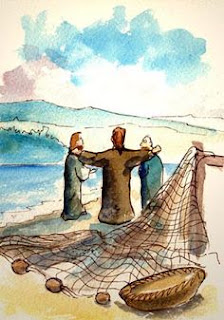
And we see this pattern emerging in today’s reading with Peter.  Clearly, he is attracted to Jesus and fascinated by him.  Why else would he allow Jesus to use his boat as a teaching platform and why else would he go out to the deep water and let down his nets when he knows darn well from a whole night’s toil there are no fish out there!  As soon as he apprehends the size and scope of the miraculous catch he realizes he is in the presence of the Holy and is completely overwhelmed with a sense of his own unworthiness.  But rather than departing from Peter, Jesus draws in closer and calls him to a higher industry – fishing for people.  Peter and his associates don’t even bother to take their fish to market.  They drop everything and immediately follow Jesus.  They have been caught.

Have you had an experience with the Holy which in any way mirrors what Rudolph Otto describes and what we see in our readings?

When a person is ordained to the deaconate in the Episcopal Church he or she kneels before a bishop who places his or her hands on your head and says a prayer to impart the gift of the Holy Spirit.  For me, this was a very powerful moment, a mixture of so many things happening all at once.  One thread present was a sense of unworthiness.  Who am I to be filling this role?  That feeling was also present (along with many others) at my marriage ceremony.  How can I possibly keep the vows and promises I am making and live into the person the ordination and marriage liturgy call me to be?  I realized at both occasions a person not feeling at least a little bit of self-doubt doesn’t fully grasp the gravity of the commitment he or she is making.

When a person is ordained to the priesthood in the Episcopal Church he or she kneels before a bishop and all the priests in attendance stand around and join in the laying on of hands.  I had been told before the ceremony to keep my neck and back straight or else all those hands pushing down on me would crush me.  It was sound advice.  I can still feel the weight of those hands, not as burdensome, but as empowering.  It was a wholly other feeling.  A young person from the parish made my ordination stole.  On it are the words from today’s reading from Isaiah, “Here I am, send me.”  I had been caught.

What have your encounters with the Holy been like?

And here is another question: do these encounters come to us completely uninitiated by us or are there things we can do to invite the Holy into our presence?

Like Moses who turned and saw the Burning Bush, I think some of our most powerful encounters with God occur at God’s whim.  I have a sense God is a bit coy and is neither captured nor coerced.  Even at a seminal moment such as ordination, the Holy One engages the human on the Holy One’s own terms.  I can share with a person being ordained to the priesthood, “Keep your back straight”, and this will continue to be sound advice.  I can even share my sense of unworthiness and empowerment, but God will work God’s way independent of my insights.  Still, has Rudolph Otto observed, these encounters bear consistent, similar traits. 

I can also testify to the times I have engaged in certain spiritual practices which have invited the Holy to be present.  For example, I have walked a labyrinth only four times, each time in a different setting (such as on the holy Island of Lindisfarne on the shores of the North Sea and in our own Parish Hall).  No matter the location, each time has resulted in a deep encounter with the Holy and each time I received a clarity changing and shaping my life moving forward.  These experiences have led me to be judicious about engaging in this particular spiritual practice because I don’t want it to become ‘common.’

One final though about how and when you might encounter the Holy.  Let’s consider again Peter’s experience.  On the one hand, I love the image of going out into the “deep water.”  It suggests there is a connection between taking a huge risk and encountering the Holy.  I’ve seen this connection manifested, for example, in people or groups who go on a mission trip to a region or country entirely different from ours and encounter people of faith whose lives lack many of our basic amenities, but whose hearts are filled with the joy, peace, self-lessness, and thanksgiving we thirst for in ours.  When, where, and how do you set off for “deep waters”? 

I also recognize this metaphor is something completely different for Peter.  He is accustomed to the deep waters.  He labors on them night after night.  For him, what is unique in today’s reading is how he goes out to do the same-old-same-old, but in a new way.  Yes, he is fishing, but now he is doing it in the daytime.  It makes no sense.  Jesus is a carpenter… a land lover.  What in the world can he offer to Peter about the skill of fishing?  But Peter is open to new possibilities.  “OK, let’s give it a try!”  It suggests being willing to break with routine and experiment may be yet another way we invite the Holy into our lives.

One of the central themes of the liturgical Season of Epiphany is God’s calling – calling you, calling me, calling us a parish, as a Church, as a people.  I pray we will always be open to the presence of the Holy, filled with awe and a sense of something unlike everything else in our lives.  May this give us a sense of place and purpose deeper than anything else we can imagine or hope for.


Monday, January 31, 2022

"I Didn't Like the Sermon!"


Luke 4:21-30

Epiphany 4 / Year C

In the 1950’s the Rev. Rufas Womble was rector of the church I served in Richmond.  Still in the area once he retired, Rufas had a reputation for telling three jokes at the beginning of every sermon.  So, in memory of him, here we go... 

After listening to a long and tedious sermon, a little boy asks his father about what the minister does for the rest of the week.  “Oh, he’s a very busy man,” the father replies.  “He takes care of church business, visits the sick, ministers to the poor, and prepares for next Sunday’s sermon.”  Then the father adds, “Talking in public isn’t an easy job, you know.”  The boy thinks about this for a while and then says, “Well, listening isn’t easy either.”

A pastor preaches a sermon titled, “The Unknown Depths of God.”  After the sermon a member of the congregation comes up to the pastor and says, “I believe you can go the deepest, stay the longest, and come up with the least of any preacher I have ever heard.”

A newly ordained minister was called to be the pastor of a small, rural congregation.  On his first Sunday he is dismayed to find one of the parishioners brings a dog to the worship service.  The young pastor speaks politely to the man and asks him kindly to leave the dog outside.  The man obliges and then takes his seat.  After the service members of the Vestry tell the new priest the man has been bringing his dog to services for years and it has never bothered anyone.  They fear the dog’s owner might never come back again.  So that afternoon the priest pays a visit to the man’s house and apologizes.  “Don’t worry about it a bit,” the man replies, “It all worked out,” he says.  “I wouldn’t have wanted my dog to hear that sermon anyway.”

Like the first joke, most preachers have the reputation of going on too long.  Like the second, some have a reputation of having nothing much to say.  Like the final joke, a few have a reputation of being able to infuriate on a consistent basis.

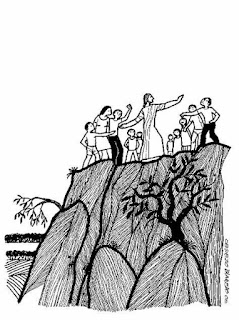
In today’s Gospel reading we pick up where last Sunday’s lesson left off.  You remember how Jesus goes to his hometown synagogue and is asked to read the scripture lesson and offer comment.  What we hear today is the response.  Jesus’ sermon was not long.  In fact, it was very brief.  It was not shallow.  But boy, did it ever infuriate the congregation.  They are so mad at him they take him to the outskirts of town and nearly throw him headfirst off a cliff.  Years ago at the church I served in Iowa, a local banker so loathed the preacher’s sermons he paid to have the Sunday newspaper delivered right to his church pew where he made a show of reading it during the sermon.  As rude as that was, it doesn’t come close to what the people of Nazareth attempted.

Have you ever heard a sermon that made you mad?  I mean really mad?  Sometimes it can be a good thing.  Sometimes we need to be brought up short and called to account—sometimes.  But sometimes preachers irritate and to no real end—sometimes.  And sometimes we get upset because we think the preacher should have said something else.

I suppose every preacher has his or her own definition of a sermon and each has his or her own unique approach to this very complicated enterprise.  For me, listening to a sermon is listening in on a conversation.  It is a conversation that has been taking place in the heart, mind, and soul of the preacher.  Participants in the conversation include the Holy Spirit, the lessons assigned to be read, the liturgical time of the year, events in the life of the congregation and its members, current national and world events, and a whole host of other voices that come from books, articles, lectures, and previous experiences. 

The majority of the conversation takes place during the course of the week leading up to Sunday’s service; although some parts of it have been going on in the preacher’s innermost being for weeks and months and years.  Each Sunday the preacher attempts to summarize the conversation in a way that is interesting, challenging, enlightening, and spiritually filling to the listening congregation. 

I know most people listen to sermons hoping to learn something about God, about the Bible, and about life.  Most of the time we listen to gain a new perspective on these important matters.  I also know it is easy to fall into the habit of listening to hear things you agree with and disagree with. 

Some years ago one of my colleagues wrote this in his church’s newsletter:

Sermons are intended to challenge people with the Gospel message.  As such they are not meant to be mere reflections of conventional wisdom.  They are meant to question, to stimulate, and to call us to repentance and change.  If you have listened to a sermon that does not call you to these things then chances are you have not heard a good sermon.

If you hear something that upsets you there are several things you can do.  First, ask yourself if you heard exactly what the preacher said.  Perhaps you misunderstood.  Second, ask yourself if the preacher is right.  Sometimes we react negatively to something we know is true, but we do not want to hear.  Next, go to the preacher and seek clarification.  Statements like; “Tell me more about your thoughts on this subject” or “Did I understand you correctly when you said…” are good ways to engage the preacher.  Finally, pray about what you have heard.  Pray for yourself and pray for the preacher.  Pray that God’s will and God’s word would be known by both of you.

I don’t know what the response was to his article, but I always thought it was good advice.

Because the sermon is an articulation of an inner conversation, the best response to a sermon is more conversation.  It is a conversation taking place in the heart, mind, and soul of the listener during the sermon and the days that follow.  The best sermon complements I receive are the ones when somebody stops by the office and begins a conversation by saying, “I have been thinking about what you said in your sermon last Sunday…”

If the only spiritual food you receive all week comes from the sermon they it is likely you will be hungry most of the time.  Sermons function best when they are used as water to prime your spiritual pump.  Without them sometimes it can be difficult to get the water flowing.  With their assistance, the spiritual well inside of you can deliver reservoirs of living water.  

In our Old Testament reading for today, God says to Jeremiah, “I have put My words in your mouth.”  We might ask ourselves who speaks for God in this place.  Upon whose lips has God placed God’s words?  I dare say God’s words are not the exclusive domain of the preacher.  We all speak for God.  Collectively we have God’s word in us.  Discovering this truth, embracing, and unleashing its power ought to be one of our highest priorities.  How will we begin to do it?