Monday, April 25, 2022

Permission to Doubt


John 20:19-31

Easter 2 / Year C

Today is often referred to as “Doubting Thomas Sunday” because the Lectionary always assigns the reading we just heard to be read on the Sunday after Easter.  It serves to remind us the claims of Christianity are not at all easy to affirm.  Faith, one person noted, is belief without proof – not an easy thing for the modern mind to do… or for Thomas.

Many Christians act as if a prohibition against doubting is one of the 10 Commandments.  Nothing will make a person feel worse about his or her faith faster than the presence of doubts.  And doubts seem to come in one of two forms: Either a person doubts God will come through on a promise or assurance (like protection or guidance or healing) or a person cannot subscribe to one or more central tenets of the Christian faith – our core beliefs.  Let me say a brief word about each.

More than one person, while in the midst of tremendous personal suffering, has confessed to me about struggling with what they consider to be the “sin” of doubt: “I know I should trust in God, but it is so hard right now.”  My response:

It is very easy to confuse doubt with being disheartened.  It is very difficult to look up when everything around you is looking so down.  Believe me, God gets it.  When so much else is weighing you down, there is no need to heap more guilt on yourself.  Tell God you are discouraged and ask for help.  It is not always obvious how God will respond or who God will send to you to help see you through, but it will happen.  All you need to do is be on the lookout.

The second kind of doubt is more intellectual than emotional and has to do with the teachings of the faith.  Here, the opposite of doubt is not faith, but certainty… and if you have ever known anyone who is certain about everything they believe, you know this is not necessarily a desirable trait.  Paul Tillich, the great theologian of the last century, held doubt is an element of faith – the questioning which is absolutely necessary to our response to God if our faith is going to be anything more than an idol of our own creation.

Those of you who join me on-line for services of Morning Prayer know we recite the Apostles’ Creed pretty much every single day.  Developed in the early 5th century in Gaul, it consists of twelve statements of the faith, grouped together in a Trinitarian structure: “I believe in God”… “I believe in Jesus Christ”… “I believe in the Holy Spirit.”  A tradition emerged crediting each of the twelve Apostles with adding one line to this creed.  The other day I got to thinking it would be an interesting exercise for some adult group to take each of the statements separately and arrange them in order of “believability” – the easiest to affirm to the most difficult.

At the top of my list would be:

He suffered under Pontius Pilate,

was crucified, died, and was buried.

I believe in the forgiveness of sins.

I believe in the communion of saints.

I believe in the holy catholic Church.

Most problematic for me:

I believe in the resurrection of the body

He will come again to judge the living and the dead

Another day and another time, I can say more about this, but for now let me simply convey I am happy to be a part of the faith while embracing certain questions about what it teaches.

In this sense I see myself in Thomas.  He manages to spend an entire week with a roomful of people who are rock-solid in their belief the Risen Lord has appeared to them while he himself cannot possibly fathom how such a thing can be possible.  Thomas represents doubt dwelling in the midst of faith. 

A part of me wishes this story could be read on Easter Sunday.  So many people attend that service who may not be here again until Christmas.  I am sure more than one of them has significant questions/doubts about this whole Christianity thing.  Drawing on Thomas’ experience, to them I would say this is exactly where you need to bring your doubts and hang out.  Don’t stay away until you have it all figured out.  Don’t stay away until it all makes sense.  Don’t stay away until there is a scientific explanation for the Virgin birth and the bodily Ascension into heaven. 

Thomas reminds us not only are doubters welcome in the church, in many ways we are necessary.  We don’t deny the faith.  Rather, we push it to new places and new insights and new understandings.  There is no evidence any of Thomas’ colleagues thought a physical inspection of Christ’s wounds mattered.  But to Tomas it did.  And countless many, given the evidence he (in his doubts) gathered, have come to believe.  Your doubts are not doors to padlock and keep out of sight, but avenues to explore, knowing faith always finds a place of serenity.  Why else would Jesus repeatedly greet his friends by saying, “Peace [not certainty] be with you?”


Monday, April 18, 2022

The Myrrh-Bearers


Luke 24:1-12

Easter Sunday / Year C

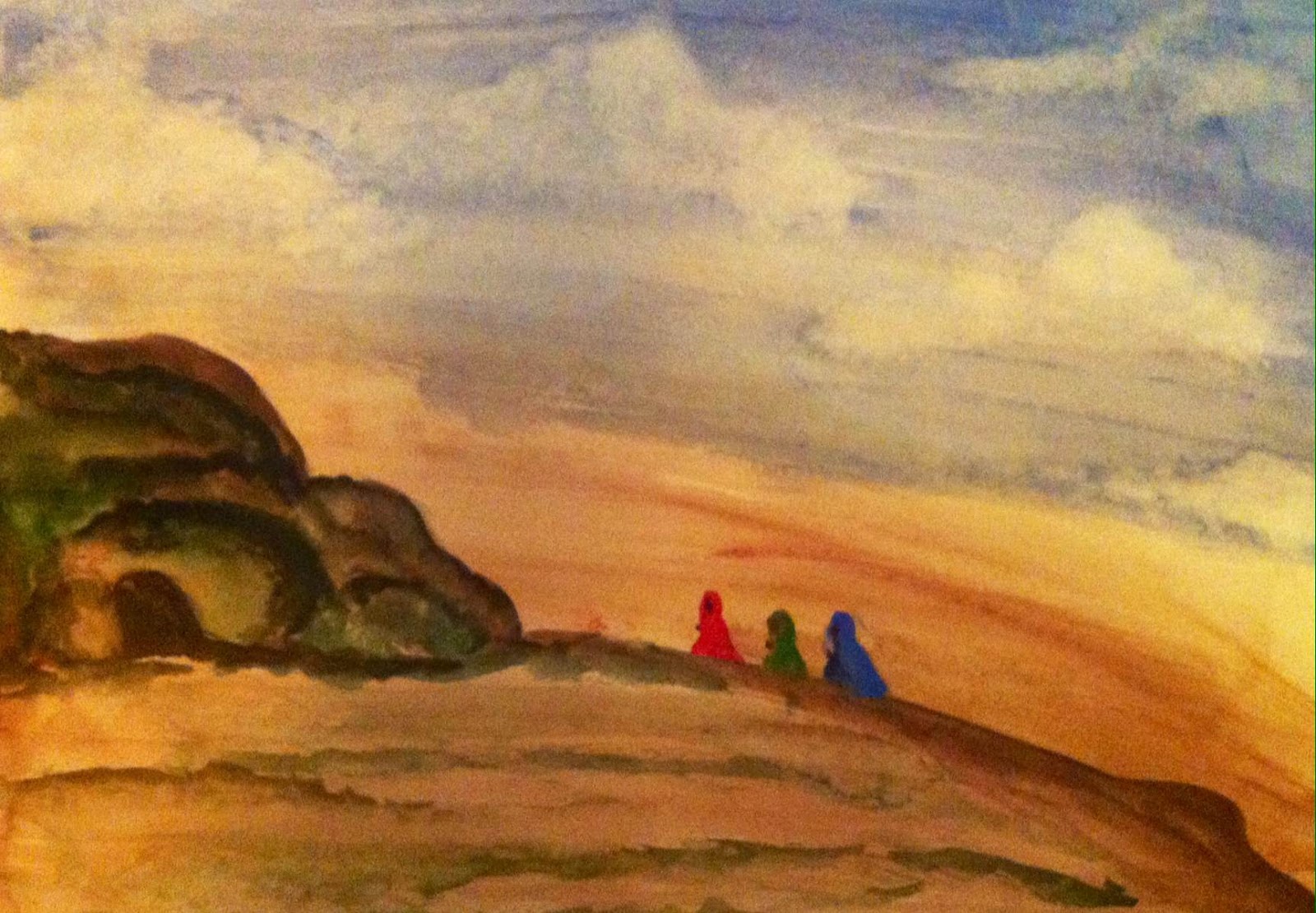
They are known as the “Myrrh-Bearers” and many Eastern Orthodox Churches will celebrate them next Sunday.  They are the women who carry burial ointments to Jesus’ tomb in the pre-dawn hours after the Passover Sabbath.  These women play a pivotal, if unheralded role throughout Jesus’ ministry; travelling with him and supporting him financially [see Luke 8:3] during his long periods away from the carpenter’s shop.  They accompany Jesus throughout the agonizing ordeal as he bears his cross to Golgotha.  They watch in silence as he suffers and dies.  They follow Joseph of Arimathea and Nicodemus to a nearby burial garden where Jesus’ body is entombed.  They watch the men tend to the corpse; wrapping it in a linen shroud saturated with 100 pounds of burial spices (five times the typical amount).  They witness a stone rolled to seal the tomb’s entrance.  No doubt they stay as long as twilight lets them dare, lest they break the Passover law of being away from home after sundown.

Surely during the Passover they are heart-broken.  It is likely no elaborate meal is served because they were preoccupied throughout the time normally reserved for its preparation.  They and their families go without on this holy day.  They wait.  They wait for the sun to go down and the Passover to end and for the first hint of dawn providing some measure of light sufficient for them to make their way back to Jesus’ tomb with more burial spices. 

I don’t have the words to begin to describe the devotion these women hold for Jesus.  Tradition has it there are eight Myrrh-Bearers, although the gospels do not agree on who or how many (most likely a reflection of the four authors’ indifference to the significant role each woman plays in Jesus’ life and ministry).  Here are the people who are a part of this hallowed group:

· Mary, the mother of Jesus (who is also referred to in the Eastern Church as ‘the Theotokos,” which is Greek for ‘God-bearer.”)

· Mary of Magdala (a Galilean who either was a prostitute or possessed by demons – or both – before Jesus meets her.  She becomes one of his ‘closest’ followers – how close is a matter of speculation.  The gospel writers seem to agree she either is the first person to encounter the Risen Christ or is with a group of other women who share the experience).

· Now, this is where things get confusing because there is yet another Mary, who is identified as “the wife of Cleopas.”  This Mary may be the sister of Jesus’ mother (making her his aunt).  Or, she could be the wife of Zebedee, making her the mother of James and John, two of Jesus’ most prominent followers.  In this case, her name is also referred to in the gospels as “Salome.”  With this possibility, she may be the sister of the Virgin Mary or Cleopas may have been the brother of Jesus’ father, Joseph, making him Jesus’ uncle and again this Mary his aunt.  To make this even more confusing, this Mary is also referred to as the wife of ‘Alphaeus’, who is said to be the father of James, Jesus’ brother, who one day becomes the leader of the church in Jerusalem.  This scenario means this Mary and the Virgin Mary are one in the same.  Yet another Mary is identified as “the mother of James and Joses”, common names at the time which do not help to distinguish one Mary from another.  Somewhere in all of this are two additional women who go to the tomb.

· Joanna is the wife of Chuza, a highly placed steward in King Herod’s palace.  While this is more straight-forward than the multiple Mary possibilities, it begs the question how such a well-to-do person in society comes to be one of Jesus’ devoted followers.

· Susanna, about whom all we know is Jesus healed her of an unidentified infirmity and she possessed the financial means to be a supporter his ministry.

· Mary and Martha, the sisters from Bethany whose brother Lazarus Jesus raised from the dead.

As some configuration of all these women (possibly accompanied by others not named) makes their way to Jesus’ tomb they wonder how they will move the stone.  Matthew reports a Roman guard has been assigned to safeguard the site.  No doubt the women know nothing about this added obstacle, but it too will be a challenge they will have to overcome.  Even though Jesus taught his closest followers often and openly he would be crucified and rise from the dead after three days, there is absolutely no indication any of these women expect to find anything other than the dead body.  Their sole focus is to mask the stench of death and decay with the oils and spices they carry.

It strikes me many of us share significant traits in common with the Myrrh-Bearers as they make their way to the garden.  Like them, we are deeply devoted.  We sacrifice much (often without giving it a second thought) in response to God’s love made known to us in and through the person of Jesus Christ.  We carry a deep sense of obligation to shepherd the values and practices of the past into the present and beyond.  We have a sense the things in which we have placed our hopes are spiraling out of control and there is little or nothing we can do about it other than to give it a proper burial.  This is what Easter looks and feels like in the pre-dawn twilight of that morning so long ago: duty, mingled with despair.

As somber as the procession to the garden must be, we who have the advantage of time and history cannot help but chuckle at these bearers of myrrh because we know there cannot be anything more unnecessary at the tomb of Jesus on Easter morning than oodles and oodles of burial ointments.  Soon enough they will learn what we are blessed to know from their witness: Alleluia, Christ is risen!  Our sense of obligation, of duty, of responsibility to all that matters to God in this world is infused with Easter joy – a personal awareness Jesus is risen from the dead and a conviction the power of gloom and death has been banished. 

We find ourselves in a moment much like the Myrrh-Bearers’ trodding to the tomb.  You know the litany as well as I: a global pandemic, a world super-power attempting to annihilate one of its neighbors, the shortage of basic consumer goods and the potential for runaway inflation, deep and on-going cultural differences ripping apart the fabric of our society…  Ponder it just for a moment and you might conclude the only sane thing to do is grab some myrrh and try to cover the stench. 

But, just as it was on that morning so long ago, don’t be surprised if you arrive at the tomb, find the stone rolled away, the body gone, and an angel or two telling your God is not done with us yet.  So leave your myrrh at home and come here to celebrate.  We are witnesses of God’s ability to call forth joy and to make all things new. 


Friday, April 15, 2022

Maundy Thursday & Good Friday Sermons


Maundy Thursday

As you go home after tonight’s service, if you happen to pass by a fast-food restaurant (especially Chick-fil-a), check out the line of cars in the drive-thru.  It will be long and littered with SUV’s – a sure sign many American families are not gathering around a dinner table this evening for a meal.  I read recently fast-food establishments are transforming their in-person dining facilities.  Many are cutting down dramatically the size of their seating areas in favor of expanding curbside and drive-thru capacity.  What does this tell you about the current status of the American dinner experience?  I noted – with some amusement – KFC is a part of this trend.  My two reactions to this news were these: 1) I don’t eat ‘food’ from KFC, and 2) if I did, I certainly wouldn’t sit in their lobby to do it!

At the center of tonight’s service is a meal; a meal which has been given a memorable moniker – “the Last Supper” – and has been depicted by artists thousands of times over, perhaps most famously by da Vinci.  The customs and practices around meals will tell you a lot about the culture of time.  Just as the drive-thru reveals much about our day, meals in Jesus’ day expressed the social, symbolic, and spiritual values of its time. 

Think about the meals mentioned in the gospels and the stories Jesus tells centered around the sharing of food.  They are (or should be) expressions of hospitality, affirmations of kinship, friendship, and status, and settings for peaceful interactions.  Meals fell into one of three categories: ordinary, festive, and sacred and all three were understood to be spiritual occasions.  Ordinary meals might include bread, grains, olives and olive oil, and bean stews, as well various fruits, cheeses, and fish.  Festive and sacred meals added different kinds of meat to the menu.     

Meals were served indoors or in places shaded from the sun.  Typically, food was served on a low table or on mat or simply in bowls passed around among the diners.  Those eating either knelt on the floor or sat cross-legged.  Reclining by resting your head close to the chest of the person next to you was a common practice at festive and sacred meals, leading to the expression ‘bosom buddies.’  Tables with chairs, as we think of them, were reserved for royalty and the well-to-do.

Because bread was an indispensable staple at most meals it became synonymous with the meal itself.  We still hold on to the expression “breaking bread” because bread was torn off from the loaf by hand, not cut. 

Most food was passed among guests and eaten by hand directly from the dish, bowl or plate on which was served.  This led to some elaborate pre-meal practices around personal hygiene, which included washing of hands and feet as well as the use of perfume or oil.  Over time, what once served as a practical consideration (cleaning up before eating) evolved into religious obligation concerned with ritual purity.  It was customary to recite short prayers at the beginning of a meal and longer prayers of thanksgiving after the conclusion.

Various specific directions set forth etiquette for Hebrew meals; all practical, some humorous:

·    You should not talk with food in your mouth, for it can prove dangerous should it go down the windpipe.  Even saying “bless you” to person who has sneezed should be avoided.  However, if you push the food to the side of his mouth, there is no concern about talking.

·    When you distribute pieces of bread to those eating with you, you should not throw the bread to the recipient nor hand it to him directly.  Rather, it should be placed before the person on a plate or in a bowl.

·    It is improper to eat or drink while standing.

·    It is not proper to wipe your plate clean while eating so that nothing is left on it.  Some food, even a small amount, should remain.  

·    It is also improper to lick your fingers.

·    If you are a guest in a home, do not demand food to eat, rather, wait until food is offered.

·    If two people are eating together from the same plate (say, sharing olives from a common bowl) and one person stops eating in order to drink or to do another minor act, the other person needs to stop eating from the bowl and wait until his friend is ready to resume.  If, however, three people are eating from the same plate or bowl and one person interrupts his eating, it is not necessary for the other two to pause.


All of these cultural expectations serve to highlight a distinctive aspect of the first Passover meal described in tonight’s reading from the Book of Exodus:


This is how you shall eat it: your loins girded, your sandals on your feet, and your staff in your hand; and you shall eat it hurriedly. 


It is the modern day equivalent of having your child in her soccer uniform and cleats as you hit the drive thru on the way to practice.  The Passover is anything but a leisurely meal typical of the culture at the time.  It is eating on the run.  It stands out because it is the exception, not the rule.  In our time, dining is the exception.  Rushing is the norm.


The early Church soon discovered when they gathered for a communal meal – observing all the norms and customs of the day, but also remembering the last meal they shared with Jesus – the Risen Lord became known to them.  Early on, there was a physical presence.  After the Ascension, the presence was spiritual.  We experience this in our day when we gather in this place around its table and do what we do in remembrance of Christ. 


We also experience it in our homes and with our friends as we sit down for a meal where we have time truly to be present to one another.  At occasions like these, which are becoming rare in our society, God’s Spirit moves in and through the gathering in ways that refresh and restore us while bonding and binding us to one another in love. 


I miss our Agape Meal tonight because of the way it brings together the sacred and the social.  It starts with the preparation – food and decoration – continues through the meal, and lingers even into the clean-up.  It has a powerful way of connecting us to one another and of connecting us to the One who is our Host.  God willing, next year we will gather at table in the Parish Hall once again and dine with one another.  Tonight we give thanks for the opportunity to gather in this sacred meal and moment at the Lord’s Table.


Good Friday

Jesus said, “Woman, behold thy son.”

The Greek philosopher Herodotus is remembered for noting the major difference between times of peace and times of war is during peace children bury their parents and during war parents bury their children.  Whatever the political climate is, every parent carries a secret fear someday he or she will lose a child.  Without question, the most grief-filled memorial services are those where a parent has to bury a child, no matter if the child is two or thirty-two. 

What must be going through the mind of Mary, the holy mother, as she watches her son die on the Cross?

As a young girl, perhaps no older than fourteen, she is visited by an angel whose puzzling message proclaims she will conceive through the indwelling of the Holy Spirit and give birth to a son.  We find the angel’s words in Luke 1:32:

“He will be great,

and will be called the Son of the Most High;

   and the Lord God will give to him

   the throne of his father David,

and he will reign over the house of Jacob forever;

   and of his kingdom there will be no end.”

The fear-filled little girl responds, “Let it be to me according to your word.” 

Surely this is one of the memories flooding Mary’s mind as she watches her flesh and blood hang on the tree.

In the months following the angel’s visit, Mary must have endured great shame being pregnant and unwed.  Yet she is still able to make this proclamation to her cousin Elizabeth:

“My soul magnifies the Lord,

And my spirit rejoices in God my Savior,

   for He has regarded

   the low estate of his handmaiden.

For behold,

henceforth all generations will call me blessed;

   for He has done great things for me

   and holy is his Name…”

Does Mary remember these words as she grieves at Calvary?  Surely she does not perceive herself as blessed among all people on that terrible Friday afternoon.

Think of all the unusual events associated with the birth of Jesus.  Luke records on the night of Jesus’ birth shepherds come to the manger telling a story of angelic visions and choruses.  Matthew records the visit of Magi who follow a star to the place where the child can be found.  Luke also records the declarations of Simeon and Anna at Jesus’ dedication in the Temple eight days after his birth.  While these events leave others confused, the Scriptures tells us Mary ponders them while keeping them in her heart. 

Imagine how great her hopes and expectations for her son must have been.  How many days must she have held her child to her breast dreaming of what he might become?   How many nights must she have put him to sleep with a prayer entrusting him into God’s care?  How many times does she catch a glimmer of the Divine growing in her boy and how often does she wonder what glorious things God will do through him, as she has been promised? 

Can anyone at the foot of the Cross be more dissolutioned?  Can anyone be more confused?  Can anyone be more grieved than Mary?

In the midst of great physical and emotional agony Jesus is aware of his mother and her anguish.  Scholars are somewhat puzzled by his words to her, “Woman, behold thy son” and to the disciple, “Behold, thy mother.”  Mary has several other children by Joseph who are capable of caring for her.  In fact, one son – James – becomes the leader of the church in Jerusalem, so it is not clear to experts why Jesus has to entrust her to one outside the family.  But this much we do know, the disciple takes the mother of our Lord into his care from this moment on. 

From this I deduce even in the throes of his suffering Jesus has compassion for us and for our needs.  He is ever-concerned for us as evidenced by his concern for his mother.  Given this, how much more is he able to care for us now in his glory?

I also believe family lines are redrawn not as a way to deal with loss and grief, but as a foreshadowing of what life in the resurrection will be like.  In a few short days Jesus will rise from the dead and appear to his followers in triumph.  When this happens realities such as biological relations will seem trivial in light of the bonds created among believers who experience the resurrection.

Just as those who wait at the foot of the Cross are bound together by their common experience, we are united in this place at this time because we come to observe Good Friday together.  Come Sunday we will be related by more than the fact we gather together in the same place.  We will be brothers and sisters in Christ based on the power of the resurrection in our lives.  For followers of Christ there is no stronger tie than the faith uniting us in Christ.  We rejoice together.  We weep together.  Let no one make a charge against one of the elect for we are family in Christ.  As it was at the foot of the Cross between Mary and the disciple, let it be for us.


Monday, April 11, 2022

The Passion as a Mirror


The Passion of our Lord according to Luke

Year C

It is perhaps the most troubling, most upsetting thing we are asked to do in liturgical worship.  Once each year we are required to become part of a mob witnessing the rigged trial of a person who brought peace into the world, modeled forgiveness, loved the unlovable, and criticized the hypocrisy of the elite, be they political, religious, or the indifferent well-to-do.  And with the mob we are forced to render a verdict. 

“Crucify him!  Crucify him!” 

The words which rang out in the courtyard in front of Pilate’s residence centuries ago become our words echoing throughout this space – this space where we come to be married, to baptize our children, to receive the sacrament, to ask God’s care and keep before we bury a loved one.  “Crucify him!” seems so out of step with everything else this place is for us, and yet it is here on this day we are directed to say these words; words which in some way link us to the original throng and make us culpable with them.

It has been well chronicled crucifixion is one of the cruelest, most painful forms of execution ever devised.  Mel Gibson’s 2004 movie The Passion of Christ was criticized for its extreme, graphic depiction, but (at least to my way of thinking), it was probably far tamer than the real thing.  I have heard numerous sermons and talks describing in detail the exact nature of the suffering crucifixion inflicts.  I will spare you the details. 

Typically, the point of such preaching is to impress upon the listener the pain and punishment Jesus took upon himself to pay the penalty for our sins.  The whole point of Passion Sunday, then, is to impose a quilt trip which will drive us to our knees in remorse.  This then motivates us to amend our lives moving forward in grateful acknowledgement of all Christ has won for us through his suffering on our behalf.  When accompanied by an extreme emotional response, it becomes what is known as a “conversion experience.”

This process is known as the atonement theory of the Crucifixion:

9    We are all sinners.

9    Sin demands punishment.

9    The punishment is death.

9    It is a cost too great for us to pay.

9    Christ, being sinless, pays the price (or atones) on our behalf. 

It is a nice, tidy theology, certainly with biblical roots and support from the ancient Hebrew sacrificial system.  But I wonder if we are missing something when the complex events of this day become as describable as a recipe for baking chocolate chip cookies.

In 1972, a French writer by the name of Rene Girard authored an influential and somewhat dense book titled Violence and the Sacred in which he explored the ritual role of sacrifice in diverse religious and cultural systems.  His work has been hailed by many for analyzing how socially sanctioned violence (like crucifixion) has been played out in many different cultures and ages. 

Girard sees in the Cross a kind of mirror which forces us to look at ourselves and at our society.  And what we see when we look at ourselves is our most violent tendencies, from political institutions to personal encounters.  In the Cross we see our tendency to scapegoat the weak and marginalized in order to absolve and unify the whole.  When we shout “Crucify him!”, it is not because we want redemption for telling petty lies or sneaking a second helping of dessert.  We are proclaiming Jesus must die because he threatens the status quo by calling into question fundamental aspects of our society and ways we benefit from them at the expense of others.

It takes a brave person to engage the news in our day and time: shootings in downtown Suffolk and a killing in northern part of our city; gunshots at McArthur Mall and Virginia Beach; gang shootings in Sacramento’s entertainment district, unspeakable, inhumane acts in the Ukraine; multiple states enacting legislation designed to marginalize the most vulnerable and misunderstood members of our society.  Ours is a violent world and the human race is a violent people.  In some way, shape, or form, every act of violence is a statement proclaiming I will get what I want at your expense, or I will make secure what I value by rendering you harmless.  This is the message mirrored back to us from the Cross.  This is what we seek when we say, “Crucify him!”  We want our lives to be better by making someone else’s worse.

The word ‘atonement’ was created by William Tyndale, the first person to translate the bible into English from original Hebrew and Greek texts.  It literally means “at-one-ment”, the bringing together of that which has been separated.  Tyndale used this word as a translation for several different biblical words which mean ‘reconciliation.’  Like so many before him, he saw in the Cross a work meant to unite God to a world estranged from God – at-one-ment – and to bridge the chasm between peoples so deeply divided against one another.  Does Jesus accomplish this by transferring the unpayable balance of our sins into his own account or did he make it possible by holding before us the worst of our behavior and calling us to repent? 

A rocket strike at a railroad station kills dozens of innocents, injuring scores more, all attempting to flee the destruction of their homeland.  Before the soldiers fired the weapon they took the time to paint on it a message: “For the Children.”  I ask you this: did Jesus die on the Cross so the sins of these perpetrators would be forgiven (the atonement theory) or to hold up to us a mirror which forces us to look at our darkest tendencies and calls us to repentance and change?

Well, either way, this much is certain: as individuals, as a people, as a society, as the human family, we desperately need God’s Spirit to fall upon us to transform us in ways we desire but cannot achieve through our own initiatives and merits.  Through the observance of Holy Week, we are invited to do more than shout “Crucify him.”  We are invited to walk with Jesus, to ponder the meaning of a symbolic foot washing, to share in the institution of his sacred meal, to stand in silence at Golgotha, to die with him, and (ultimately) to rise with him in newness of life.  It is a journey from “Crucify him” to “Create in me a new, clean heart.”  I invite you to join me on this pilgrimage of dying and new birth.


Monday, April 4, 2022

Jesus & The Sibs


John 12:1-8

Lent 5 / Year C

We Episcopalians hold the Scriptures “contain all things necessary for our salvation.”  In other words, they present us with all the information and revelation we need to carry on in the orthodox faith and life.  However, this statement of belief does not mean the Scriptures contain everything we would like to know.  We would love to know more about Jesus’ formative years.  Why is Joseph not present during Jesus’ public ministry?  What becomes of all the people Jesus touched during his ministry – Zacchaeus (the short tax-collector in a tree), Bartimaeus (a blind beggar), Legion (the demonic chained up in a cemetery), and the Samaritan woman at the well (an outcast in her own community) to name a few?  While we may wonder about these and other things, the gospel writers deemed them to be ancillary to their main work of presenting Jesus as the Messiah.

Among the people we meet in the gospels and would like to know better are three siblings, Mary, Martha, and Lazarus of Bethany (a town about two miles southeast from Jerusalem on the opposite side of the Mount of Olives).  Here is what we know about them:

· They are very close and supportive friends of Jesus.

· They host him and his followers in their home at least twice, providing meals and hospitality for a large party at each occasion.

· At the first recorded gathering Mary sits at Jesus’ feet listening to his teaching while Martha (the older sister) busies herself with the details of preparing a meal and serving.  Martha finds this irksome and complains. 

· At a later time, Lazarus becomes ill and the sisters send word to Jesus.  Jesus delays and Lazarus dies.  He arrives four days later.  Each sister believes he could have saved their brother, but each also professes a belief in the eventual Resurrection of the dead.  Jesus goes to the tomb of his friend, weeps, and calls him back to life.

· This event becomes known throughout the region and it is so threatening to Temple officials they begin to seek a course of action to have Jesus arrested and executed.

· Lazarus himself, telling his story often and everywhere, becomes a threat and the same officials seek to have him put to death as well.

· A week before the Passover Jesus is at his friends’ home and Mary anoints his feet with a costly perfume while Martha serves a meal (this time seeming at peace with her role).  Judas becomes upset at the lavish nature of Mary’s gesture and Jesus’ response becomes the impetus driving him to betrayal.

From what we know, it is obvious Mary, Martha, and Lazarus are a significant part of Jesus’ life and ministry.  Here is what we don’t know:

· The three siblings appear not to be married, live together, and have some means.  What is their story?

· How initially do they meet Jesus and become so devoted to him?

· Do they travel with Jesus on any of his missionary journeys?

· Does Jesus stay with them during his many visits to Jerusalem for religious festivals, including the final days of his life?

· Is either sister among the women present at Golgotha for the crucifixion and does either go to the tomb early on Easter morning to anoint the body with burial perfumes?

· What becomes of the three after the Resurrection?  We hear nothing more about them in Scripture, which seems odd.

Here is a possible scenario answering at least some of these questions:

We learn from other passages in the gospels (Matthew 26:6-13, Mark 14:3-9) the home in Bethany Jesus visits is owned by Simon (a common name in the New Testament), who is given the surname “the Leper”.

There are a couple of things confusing about this.  First, there is another incident in Bethany where Jesus is having a meal in the house of Simon who is a Pharisee (Luke 7:36-50) when a “woman who is a sinner” anoints Jesus’ feet with costly perfume and her tears.  Some are tempted to combine these events, making them different ways of telling the same story.  But there are significant differences between the two and it is best to understand them has separate events. 

If Simon the Leper is the father of the three siblings, and if Jesus heals him, this goes a long way in explaining their devotion to him.  However, there is no mention in the gospels of Jesus healing a leper by the name of Simon.  In addition, the designation “the Leper” is in the present tense, as if Simon still has the disease.  If this is the case, we are left to wonder why he is still allowed to live in the same home as his children, rather than being consigned to a leper colony.

It is possible the designation “Leper” is a mistranslation from way back because very closely related to this Greek word is one which means “the Potter.”  If Simon is in the pottery business this explains both the family’s affluence as well as Mary’s access to an expensive alabaster jar of ointment. 

Most likely we will never know how Jesus initially meets the three siblings or how we can account for their devotion to him.  Perhaps it is as simple as they hear him teaching in the Temple one day, are drawn to his message, and invite him to their home.  And most likely they are much more involved in the events of Jesus’ life and ministry than the gospels record. 

After the Resurrection, the most notable Christian tradition holds the siblings flee to Cyprus where Lazarus eventually serves a bishop before dying of natural causes.  Another lesser tradition holds they flee to Gaul and again, Lazarus becomes a bishop.  However, this tradition holds he is beheaded during a period of persecution against Christians.

Here are some things Jesus’ friendship with Mary, Martha, and Lazarus tells us about him: 

· First, Jesus values compassion over potential conflict and personal harm.  He does for his friends even knowing his actions will comprise his own safety. 

· We learn he is a person of deep emotion who is grieved to the core by the death of a friend.

· We hear his friends express their disappointment in him, but he does not lash out in response.

· We witness how he willingly receives gestures of comfort and respite – a meal, a tender caress.

· He seems very protective of his friends – especially Mary.  Both when Martha criticizes her and when Judas criticizes her, Jesus comes to her defense.

In 1855, when Joseph Scriven wrote “What a friend we have in Jesus”, he honed in on “all my sins and griefs to bear.”  From his relationship with this one family we discover Jesus is capable of a kind of friendship which goes well beyond utilitarian – if you do this for me, I will do something for you.  Jesus offers friendship marked by intimacy, caring, openness, and selflessness.  Can you use a friend like this?


Monday, March 28, 2022

The New Days


Joshua 5:9-12

Lent 2 / Year C

We had an early-afternoon appointment with our OBGYN a week before the due-date of our second daughter.  My wife was experiencing “back labor”, which apparently is uncomfortable.  Because Abbey was scheduled to be a C-section delivery, the doctor said, “You have gone long enough.  Let me call the hospital and see when they have an OR available.”  The word came back… 5:00 PM.  We went home, packed a bag, made arrangements for friends to care for our older daughter, fed the dog, and headed to the hospital.  One the way we stopped at a camera shop to pick up a couple of rolls of film and video tape to record the momentous occasion.  I still recall looking at my watch.  It was 3:30.  How odd, I thought, in 90 minutes our lives will never be the same; odd not that it was happening, but to be in possession of such knowledge down to the exact minute.

Life’s major transitions don’t always come so neatly scheduled, but some do.  Graduation.  Moving into a new house.  Starting a new job.  Your wedding day.  Relocating to a state.  Your last scheduled day of treatment before being given a clean bill of health.  Turning 16, 18, or 21, with all the new opportunities each age confers.  Retirement.  As I noted in Friday’s e-news, transitions come in many shapes and sizes; expected or unexpected; rapid or drawn out; anticipated or dreaded; embraced or resisted. 

In today’s first lesson, we read about a transition which has been a long-time coming.  God’s people, once enslaved in Egypt, cross the Jordon River and return to the Promised Land.  It has been forty years since the Exodus.  No adult whose feet touched the dry bottom of the Red Sea is still alive.  This is a new day for God’s new people, who bear the stories, traditions, heritage, and identity of their ancestors.  Some of it will translate into their new environment.  Much of it will not.

I remember graduating from seminary in Mid-May of 1987.  While it was a goal I worked hard to achieve, I had an overwhelming sense a significant part of my life was dying.  The community I had joined would never again be together in the same form or fashion.  Many of the daily routines and rituals I had come to enjoy would be left behind or drastically altered.  I was no longer a student receiving the wisdom of the church’s best and brightest.  It was now time for me to produce… something… somehow.

The next few weeks were a feverous whirl of events.  Moving back to Ohio.  Sleeping on a friend’s couch until I could rent a place of my own.  Being ordained a deacon.  And then, about fifty days after leaving the hallowed grounds of Virginia Seminary (affectionately known as ‘the Holy Hill’), came Day One of working in a church.  I sat in my office, which overlooked an alleyway, stared at the typewriter lounging on my desk, and wondered to myself, “What am I supposed to do now?”  Clueless, I took out a calculator, pencil, and paper and counted the number of Sunday’s until the day I retire – 2,444, give or take, and maybe something like 14,600 days.

Our very brief reading from the Book of Joshua belies the significance of the event it describes.  As if the transition from wilderness wandering to settled occupation was not enough, this day also represents the fulfillment of the promise Abram received from God centuries earlier when he lived in the region of Ur – “Take up family and possessions and go to a land I will show you.  I will be with you there and your descendants will prosper.”  This part of the story weaves through three generations in the Book of Genesis, makes its way to Egypt and several more generations in the Book of Exodus, and lumbers on through four decades of aimlessness in the Sinai before concluding with today’s reading.

The concise description of this time rings true to life.  Joshua and God’s people must decide what from their past is useful in their present and will translate into their future.  They decide to undergo the rite of circumcision (the sign of the covenant) and to celebrate the Passover Meal (reliving the events delivering their parents and grandparents from bondage to freedom).  They also decide to bring with them sacred objects accumulated on the way; chief of which is the ark with the Tablets of Law.  And finally, we learn some things from the transitional time are no longer appropriate, needed, or available to God’s people; specifically, the manna (or food from heaven) ceases and each person must now live off the fruit of his or her own labor. 

I suspect if you contemplate some of the transitions in your own life you will see a emerge a pattern similar to this – the holdovers, the new acquisitions, what is going to be left behind, and what has to be taken on.

After two years, it feels like we are at a transitional point with the pandemic.  While there is not a specific date or event marking the moment, the past few weeks have seen a dramatic change, haven’t they.  Although most of us reside in the same physical space and many of us hold the same job as before, so much about life has changed.  We have lost some folks to the virus.  Some relationships have drifted apart.  We have aged and become more isolated.  Some are bitter at what has been lost.  Some bristle at the sacrifices required to see us through.  Some are more anxious and uncertain.  I don’t know about you, but I start to wretch when I hear a modern-day ‘prophet’ tell me everything about the world has completely changed or there is no going back to the way things used to be. 

This transition will be like all that have come before.  We will figure out the most important memories and rituals to carry into the future.  We will figure out which of our pandemic adaptions will be useful as we move forward.  And we will discern what it looks like to pick up and carry on as a new day dawns.  God’s unfailing and unflagging promise to us remains the same… to be with us to lead us to a new day and a new place.  What was, was… wonderful, missed, mourned at times.  But our God is the God of what will be. 

Edgar Guest was a Detroit newspaperman and popular people’s poet of the first half and the last century.  One of his works titled The New Days pairs well with the crossing of the Jordon:

The old days, the old days,

how oft the poets sing,

The days of hope at dewy morn,

the days of early spring,

The days when every mead was fair,

and every heart was true,

And every maiden wore a smile,

and every sky was blue.

The days when dreams were golden

and every night brought rest,

The old, old days of youth and love,

the days they say were best


But I--I sing the new days,

the days that lie before.

The days of hope and fancy,

the days that I adore.

The new days, the new days,

the selfsame days they are;

The selfsame sunshine heralds them,

the selfsame evening star

Shines out to light them on their way

unto the Bygone Land,

And with the selfsame arch of blue

the world to-day is spanned.

The new days, the new days,

when friends are just as true,

And maidens smile upon us all,

the way they used to do.

Dreams we know are golden dreams,

hope springs in every breast;

It cheers us in the dewy morn

and soothes us when we rest.


The new days, the new days,

of them I want to sing,

The new days with the fancies

and the golden dreams they bring;

The old days had their pleasures,

but likewise have the new

The gardens with their roses

and the meadows bright with dew;

We love to-day the selfsame way

they loved in days of old;

The world is bathed in beauty

and it isn’t growing cold;

There’s joy for us a-plenty,

there are tasks for us to do,

And life is worth the living,

for the friends we know are true.

This morning we gather on a new side of the Jordon and give thanks for the promise and hope of the new days.